Inner Sea
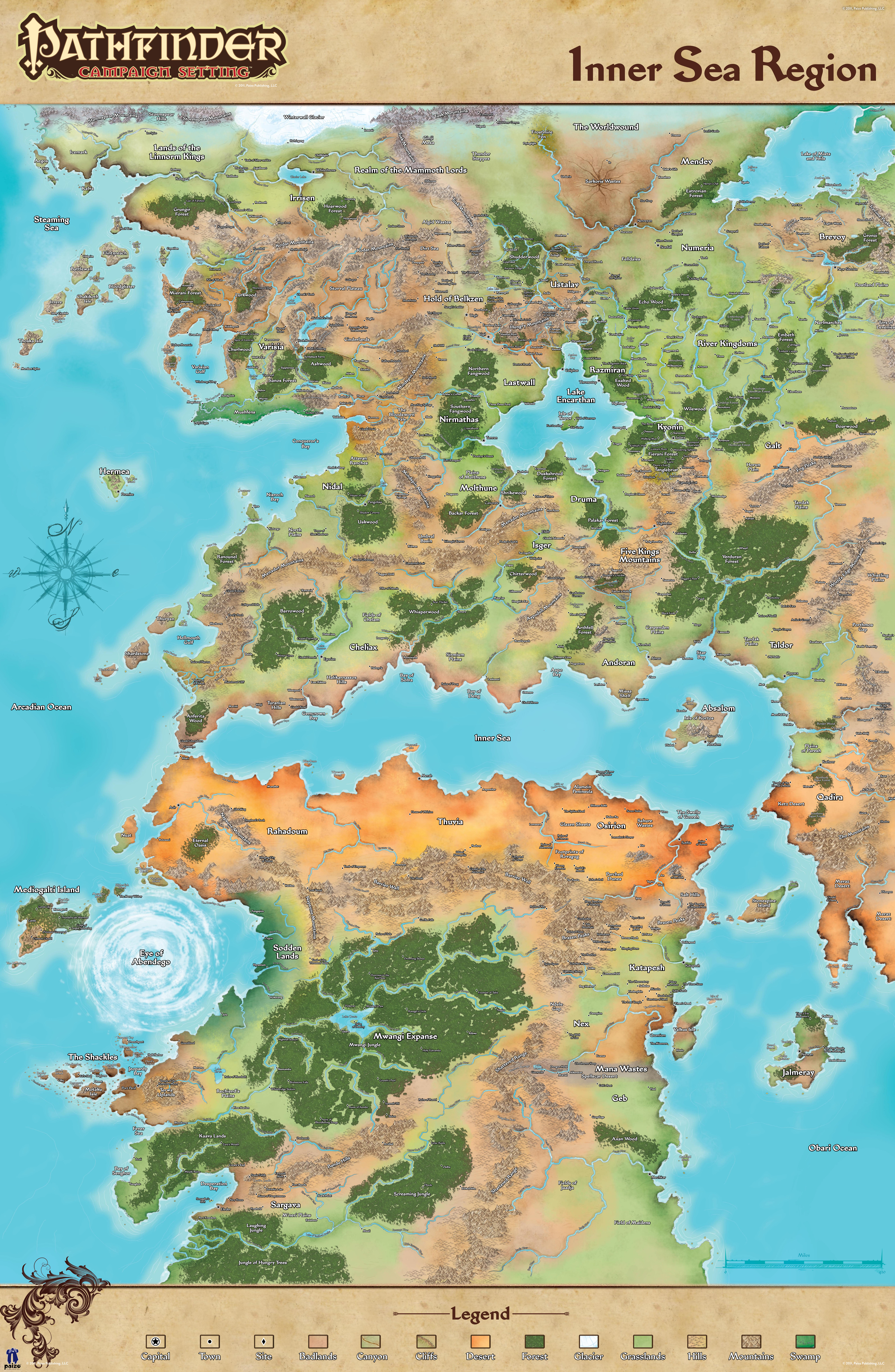 The Inner Sea region is the trading and cultural hub of two mighty continents—Avistan and Garund. At the heart of the Inner Sea’s warm waters stands Absalom, the City at the Center of the World. Founded by the living god Aroden, this ancient island city-state has survived nearly 5 millennia of toppled kingdoms to thrive as a haven of merchants and scoundrels. In the west, the Inner Sea passes through the narrow Arch of Aroden, a tenaciously contested strait named for the monolithic, ruined stone bridge connecting the two continents at their closest point of approach. To the east, the Inner Sea opens into the vast Obari Ocean.
The two continents that frame the Inner Sea are very different from one another. Avistan, to the north, is the seat of once-mighty empires like Cheliax and Taldor, and site of the ruins of Lost Thassilon in the frontier realm of Varisia. South, across the wide waterway of the Inner Sea, lie the secrets of Garund, a sprawling continent of arid deserts and fecund jungles, where the mighty pharaohs of Osirion emerged from the Age of Darkness to chart a new destiny for humanity. Generally speaking, civilization centers on the Inner Sea, with barbarism and savagery taking hold where the sea’s refining influence wanes. Exceptions exist, of course, and the scattered lights of civilization stand out in the dark wildernesses and savage frontiers far to the north in Avistan and well to the south in Garund. Likewise, dark, wild areas exist within otherwise civilized lands close to the Inner Sea. Mercenaries and would-be heroes seek fortune and glory throughout the Inner Sea region, uncovering lost treasures, pacifying terrible dangers, and finding ignoble deaths in every unclaimed wilderness, kingdom, and empire of Avistan and Garund.
North of Avistan stretches the Crown of the World, a frozen landmass that links the continent with Tian-Xia. Where the two meet, hardy barbarism tends to dominate. Even in northern kingdoms that strive for advancements in civilization, such as the Lands of the Linnorm Kings and Realm of the Mammoth Lords, the use and knowledge of arcane magic remains relatively unknown and certainly mistrusted. Even Mendev, a relatively advanced nation filled with pious (and not-so-pious) crusaders, tends to shy away from arcane magic.
Magic becomes more common in the southern nations of Avistan, particularly the devil-binding empire of Cheliax and its former colonies and vassal states. The ruling caste of shadow-haunted Nidal is suffused with forbidden magical forces, while the elves of Kyonin practice alien rites that date back millennia. On Avistan’s rocky northwestern shore, the Varisian frontier boasts the mostly intact ruins and lost magics of ancient Thassilon—a 10,000-year-gone empire ruled by sadistic wizard-kings known as runelords. Use of magic and the appearance of the fantastic and bizarre are much more commonplace on the southern continent of Garund. In the deserts of Osirion stand countless monuments to nearly forgotten pharaohs, godlike beings who raised their people from barbarism to imperial heights. Along the eastern coast lie the remnants of Nex and Geb, two kingdoms created to serve rival wizard-kings in the distant past. Today, Geb relies on animated corpses to harvest food for its living inhabitants, while the courts of Nex boast the most advanced and least understood schools of arcane learning on the planet. Between these former enemies stretches a magic-dead tract of desert known as the Mana Wastes, within which exists a city-state reliant on technology and advanced engineering in a world dependant on the supernatural. Deep in the heart of Garund, across the Shattered Range mountains, ancient ruins of unknown origin rise out of wild, uncivilized jungles. Scattered throughout the mountains surrounding the vast jungles of the Mwangi Expanse lie the ruins of once-miraculous flying cities of the Shory, long since crashed into the rocky slopes where they now rest.